


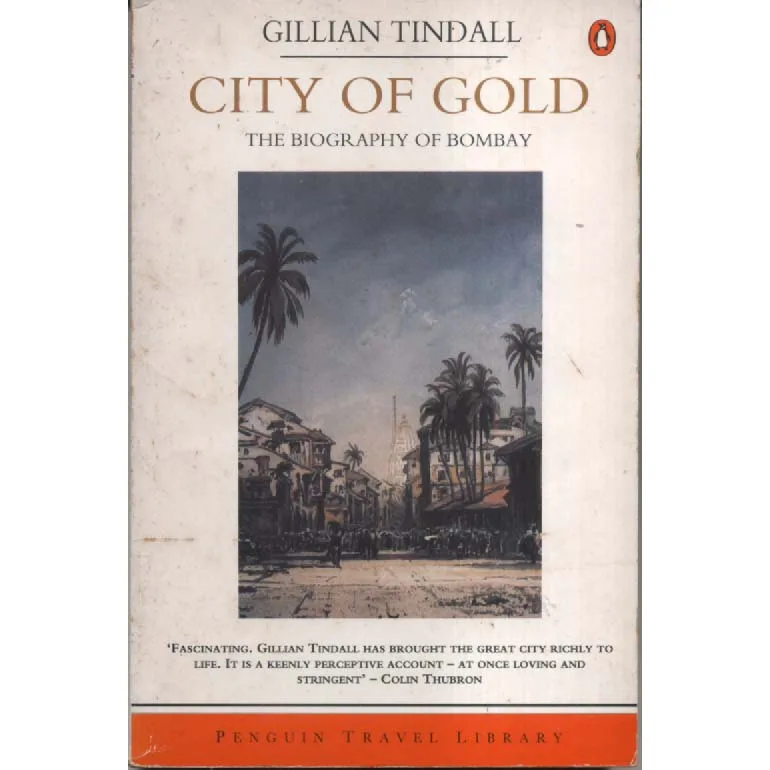
City Of Gold - Biography Of Bombay
Publisher: Penguin Books
Format: Paperback
ISBN: 9780140095005
Some cities acquire nicknames; others acquire biographies. City of Gold – Biography of Bombay (1992) by Gillian Tindall belongs to the latter, more ambitious category: an attempt not merely to describe a place, but to follow its life story as though it were a character with habits, contradictions, and a tendency to refuse neat conclusions.
Bombay—now Mumbai, though the book politely retains its earlier name—has rarely suffered from a shortage of attention, but Tindall approaches it with a measured curiosity that feels less like sightseeing and more like investigation. This is not a glossy celebration of skyline and spectacle. Instead, it’s a layered, attentive account of how a cluster of islands became a city of improbable scale, stitched together by trade, migration, colonial ambition, and the occasional bout of organised chaos. If you were hoping for a simple narrative, you may find yourself gently redirected.
What emerges is a portrait of a city that seems to operate on several timelines at once. Streets hold echoes of earlier worlds; buildings carry the weight of decisions made long ago; and daily life proceeds with a kind of determined improvisation that resists tidy explanation. Tindall doesn’t rush to impose order on this complexity. She observes, connects, and occasionally steps back, allowing Bombay to remain gloriously, stubbornly itself.
Published by Penguin in 1992, the book has the reassuringly practical feel of a volume designed to be read rather than admired from a distance. This particular copy is listed as Good, which in Crappy Old Books terms suggests it has been handled, perhaps travelled with, and very likely opened at moments when the reader wanted to understand just a little more about how cities come to be what they are. The cover may show some wear, the spine may have softened, and the pages may carry the faint signs of previous engagement—nothing dramatic, just the quiet evidence of a book that has been part of someone’s thinking.
It’s not a guidebook, and it’s not quite a conventional history. It sits somewhere in between, offering context without insisting on conclusions, detail without overwhelming, and a sense that the story of Bombay is less something to be finished than something to be followed for a while. You can read it straight through, or dip in as curiosity dictates; either way, it has a habit of making the familiar seem more complicated, and the distant a little more immediate.
A thoughtful, quietly absorbing account of a city that refuses to stand still, and a very respectable way to suggest that your interest in places extends beyond maps and into the far more interesting question of how they came to exist in the first place.
Keep browsing: See more History books Other books by Gillian Tindall
